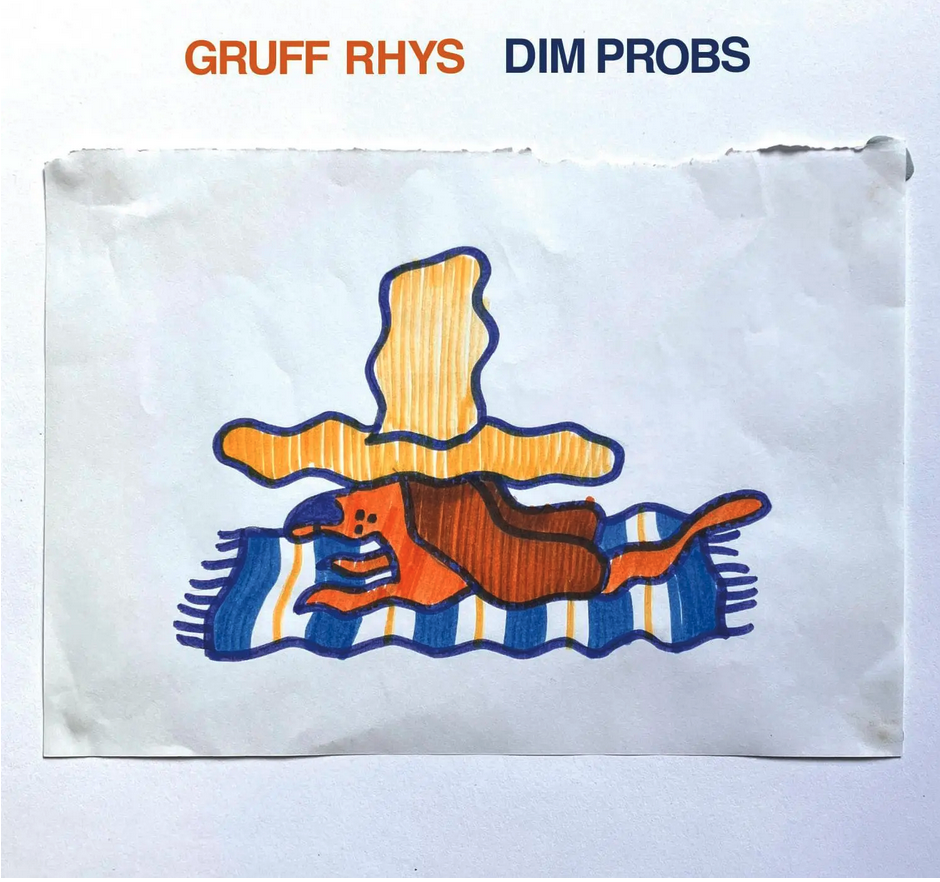
New writing: Gruff Rhys / Dim Probs

It takes only the first thirty seconds of ‘Pan Ddaw’r Haul I Fore’, the opening track of Gruff Rhys’ ninth solo album, to be reminded of his greatness, reliability and relentless unpredictability.
Like much of his previous work, whether with Super Furry Animals, solo or in his many collaborations, the greatest strength throughout is Rhys’ voice, which often goes relatively unheralded amid the elaborate arrangements, excellent songwriting or eccentricity that have characterised his career to date.
But it is the one constant, a north star that congeals the disparate elements of his work: an instantly recognisable, soothing and melodic instrument. At times layered on thick and melodic, at others more nasal and guttural, it never jars and frequently soars across the many musical contexts in which it has appeared.
It makes for a solid bedrock and is the reason why, unlike most similarly prolific artists, Rhys has never made a truly bad record. Some of his albums may be more challenging than others depending on personal preference, but the breadth and range, along with and endless willingness to experiment with different instruments, genres, narratives, languages and collaborators means that few would be struggling to find some joy across his body of work.
All of this serves as something of a context for ‘Dim Probs’, his fourth fully Welsh language album, and something of a counterpoint to its immediate predecessor, ‘Sadness Set Me Free’. While the latter had an abundance of catchy pop songs embellished with strings and horns, ‘Dim Probs’ is, by his own definition, more “sketchy”.
It is, as this would suggest, more impressionistic and lo-fi but it shares an internal cohesion. Much of the record was composed on a ‘cheap Swedish catalogue guitar’ with limited augmentation coming from his live band and via some backing vocals from Cate Le Bon and H Hawkline on one of the album’s standout songs, ‘Chwyn Chwyldroadol’. But even in its brighter moments like this and ‘Taro #1 and #2’, ‘Dim Probs’ draws the listener in rather than demanding their attention.
To a non-Welsh speaker, the joy is in the simplicity, repetition and sparseness and, to be honest, Rhys could be singing anything, and it would still sound good. The offered (Google) translations are more of a distraction than a help in unpacking meaning, and here Jarvis Cocker’s mantra of ‘please do not read the words while listening to the recordings’ might be useful. Throughout, the calming musical textures seem nicely juxtaposed with the lyrical themes of death, weeds, war and pestilence. Ignorance, in this instance, offers a certain form of bliss.
Yet this should not detract from the album’s cultural or political relevance. It began when Rhys was exploring 80s Welsh language electronic music cassettes for a potential compilation, and some 40 years later, through most of which he has been a constant on the Welsh language scene, he is very much continuing in the same fiercely independent tradition.
Having started around the time of cassettes, vinyl, Anhrefn, Ankst Records and John Peel sessions in the late 1980s, notching up the best-selling Welsh language album of all time (Super Furry Animals ‘Mwng’) along the way in the wake of Britpop and at the end of the CD era in 2000, ‘Dim Probs’ feels like the completion of a circle, an analogue outlier in the digital one. Rhys retains the punk spirit of not caring what audiences or the industry might expect or demand but continues to care very much about the music itself and his language and national identity in an outward looking, internationalist manner.
So, while ‘Dim Probs’, on initial listens, may not appear the most substantial addition to Rhys’ work, it is nevertheless a relaxed (and relaxing) thing of warm humanity and beauty that, in the long run, may be more durable than much of his more lavish and accessible outputs.